
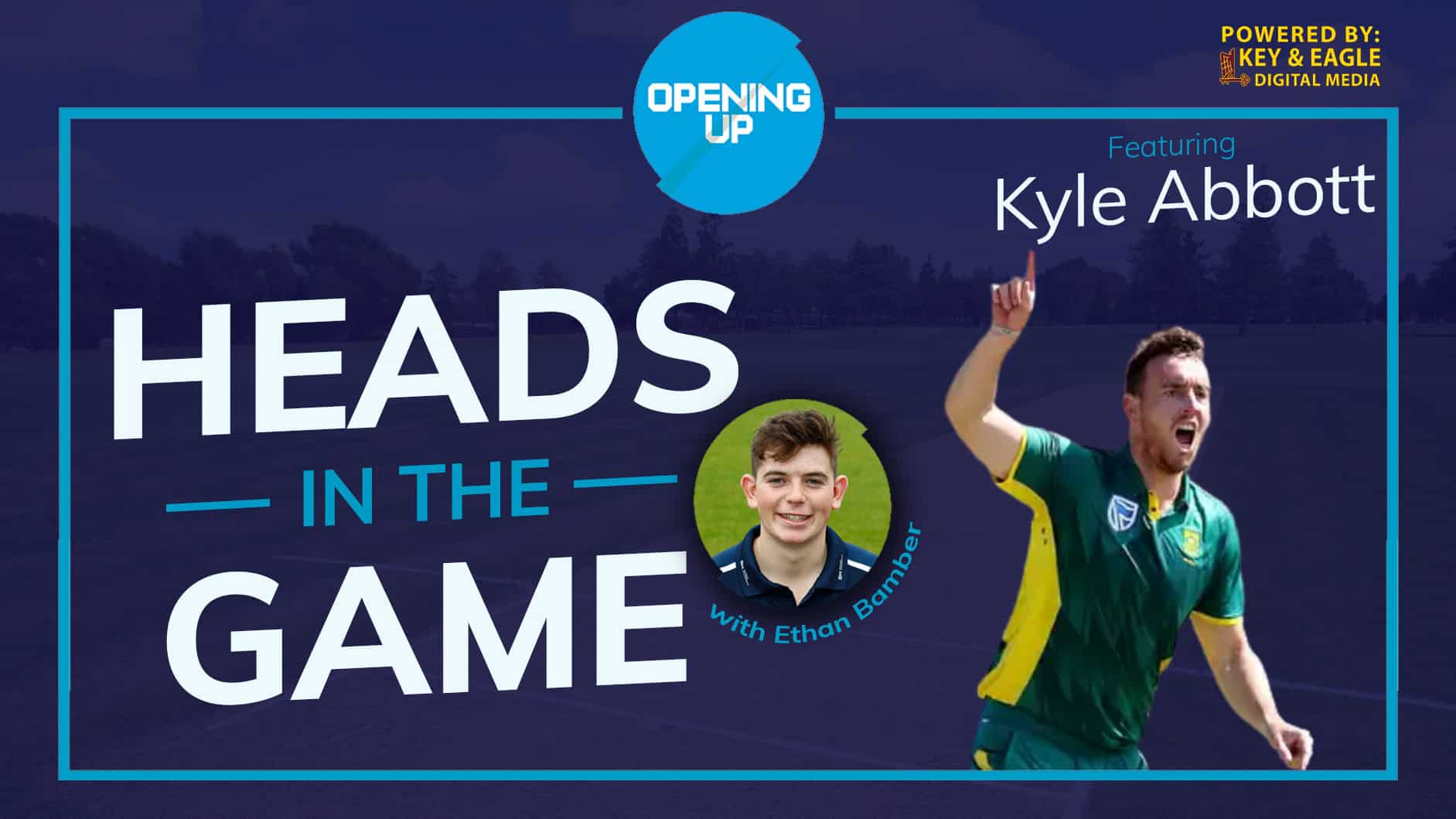
Keep it tidy’ said Lance Klusener to Kyle Abbott the night before his test debut in 2013. These words encapsulate a philosophy that seems to be present across all areas of Kyle’s life. Whether by design or total accident that advice, so refreshingly simple, seems to be reflected in his character where a relaxed confidence meets humility and discipline that are deep rooted.
Klusener’s advice certainly works on the field; Kyle took 7-29 in the first innings of that Test, and continues to average just 21 with the ball across a first class career that has spanned over 120 games. However, our conversation did not focus on statistics or performances and as we touched on Kyle’s approach to life and to cricket, and on his own understanding of mental health and wellbeing, those three words spoke to a consistent theme.
In what follows I will attempt to illustrate the perspective, consideration and clarity which he demonstrated; a person who appeared to ride the peaks and troughs of his experiences with remarkable levelheadedness and stillness. He plays cricket, but in no way does it define him.
We began our discussion by exploring his understanding of mental health, and I was immediately struck by his response. It articulated something I myself had been trying to synthesise in my mind, one of the reasons I wanted to start these interviews, in fact. “You never hear someone say ‘oh yes he’s doing very well mentally’…you never hear the good parts” he said. “The first thing that comes to me would be the negative side of it….I associate it with negativity”.
Mental health is often spoken about as an problem. It is dealt with reactively, with those suffering often having to remove themselves from view until they are ‘better’. I asked Kyle why he thought this might be, and his answer once again held a mirror up to the environments often created in sport; If someone asked ‘how are you doing?’ “my reaction would be to scream out how good I am doing…almost like it is making yourself vulnerable to say you’re not coping”.
If people feel they can’t express vulnerability, even on a ‘low’ level, then things which should be relatively minor or which have an obvious cause may fester and grow into something more serious before it is recognised. This in turn means that the subject of mental wellbeing is consistently discussed after the fact, as something which has ‘gone wrong’.
We both acknowledged, however, that discussion of mental health and wellbeing has become far more common in recent years; “There was never a door to open to explore a mental health problem….last five years or so these doors have opened up”. I assumed he thought this was a wholly good thing, but as he continued he lighted upon another problem in the way we currently engage with this topic. He used bowling as an example; “If you look for something wrong with your bowling you will find it, if you don’t look, you can just crack on…”. At face value these words may seem unsympathetic, but he clarified; “Is it just a bad day of cricket, or is there something wrong. There have been times when I have started to venture towards it but if there has been anything it has been 24 or 48 hours…guys maybe just in bad form?”.
A side effect of more prominent discussion is that, in some cases, the issue of mental health has become vogue…the ‘trendy’ thing to say. I must be very careful here to stipulate that there are many people dealing with very real struggles, and I in no way want to diminish those. However it seems important that the natural ups and downs of life, especially in professional sport, are not immediately conflated with a mental health issue.
Following this, I asked Kyle how he himself dealt with the emotional volatility of his job, one where absolute success is rarely the order of the day, even for someone as prolific as Abbott. He credits much of his current perspective to his early days at the Dolphins. “Growing up in South Africa, you have to deal with a lot of different things to anyone else…our selection policies”…this was not a political chat, but the quota system and its effect on domestic cricket is no secret. That this may have had had some effect on Kyle was no surprise either, “it was one of the hardest things for me to grasp early on…growing up I had a really short temper….those early years I could feel myself getting really worked up”.
He is now able to “pull himself out” of any frustration or disappointment more easily. It seems that in talking to senior players who reaffirmed his ability he was able to let go more easily of both injustice off the field and struggles on it. “I most definitely flirted with the line of not caring but still caring a hell of a lot…there is a very fine line of letting go…but I got the reassurance from those senior guys and I had to make myself aware that it wasn’t because of my ability”.
Perhaps it was just the result of their advice, but listening to his story, Kyle’s entry into the professional game may have also played a part in building this resilience. Following three years of club cricket in England he returned home and began working for his dad’s construction business. He seemed content, “I had given up on cricket…but to be honest I never really had ambition”. Out of the blue an old school connection saw him net bowl at the Dolphins…His first class debut and a contract followed within six months.
There appeared a remarkable contradiction between the almost accidental way in which he fell into professional cricket and the ease with which he took to it; “It never sunk in that I was doing this job…I still can’t believe I am playing professional cricket”. This almost wide eyed disbelief was married with an inner confidence, however; ‘It always felt…and maybe I was kidding myself…that ‘it’ll be ok I’ll get something next season’, and there was no chance I knew I was gunna get something”. Had this mentality ever been really challenged, I asked? Perhaps when he played for South Africa? He replied that he had put pressure on himself at just one point in his career, to really cement a place in the test side, but there were so many factors out of his control, and he soon realised it was not a sustainable approach. Following his remarkable debut, Abbott was not included in another national squad for almost a year.
Moreover, despite dominating the group stages of the 2015 World Cup he was omitted from the semi–final in favour of Vernon Philander, a decision many attributed to politics rather than form. These moments allowed Kyle rediscover the mindset that had carried him to the Proteas in the first place, it seemed; “I made myself flip it on its head…no matter how well I do or don’t do I probably won’t play another game…this could be my last, it is gunna make no difference”.
It even got to the stage that, having signed a Kolpak deal with Hampshire, he was able to play with complete freedom; “if I don’t do well, I don’t care even more so”. As a serial overthinker this was completely alien to me, but completely refreshing too. I couldn’t comprehend how you could perform whilst apparently ‘not caring’…”You actually end up playing better…I released a lot after that”, was his answer. Now of course Kyle does care, a lot, but what became clear is that he seems able to keep cricket in the box labelled ‘game’ rather than the one labelled ‘life’.
His decision to retire from international cricket was met with great frenzy and some criticism both at home and internationally, but it seems that Kyle never lost that ability to just play the game when on the field; in his first season for Hampshire he took over 60 wickets in the championship despite the scrutiny and expectation. Even in the media, the same unflappable approach was employed; “You watch that press conference… (when he announced he was leaving SA) I had gone through every one of those questions in my head a hundred times…answered them in a hundred different ways in my head”. He was prepared and considered, “it wasn’t an easy decision but it was the right one”. Just as, having entered the game from a position of relative amateurism, he had employed a singular focus to capitalise on the opportunity so too, as soon as he had made the decision to move to England, he stuck to it with absolute belief and confidence. Perhaps it was in those difficult experiences early on at the Dolphins that he found the ability to remove himself from all the ‘noise’.
I was so struck by the consistency of his approach, but I asked next about nerves and doubt. “I really did get nervous going to grounds..sh*t they are going to watch me do my job”, but when he has crossed the line he feels “in control”. His approach to the game itself may also be a contributing factor in this mentality. ‘I was never blessed with pace…but one thing I could do was bowl straight’. Under Klusener he learnt exactly how to ‘keep it tidy’.
It was fascinating to hear the resolute belief that he had in such a seemingly straightforward, basic method; “I brought into a process and I just believe in it…you do something for long enough its gunna happen”. I pushed him about an incident in a game last year where he was put under pressure by one batsman but eventually came out on top…’Did you change? Was there a ‘I’m gunna show you’ mentality?’. No. His thinking was exactly the same in that game as it had been on his first class debut, on test debut in South Africa, bowling at Kohli in Delhi and now bowling in England, he said; “I’m doing my process here…I’m not gunna change that”. There was such a weight in these words, “I could talk about it all day” he joked, but I believed him.
Having read this far it will come as no surprise to you that, when we spoke about life away from cricket, Kyle seemed equally at ease. The sport is a part of his life, it is certainly not his whole life; “I don’t watch much sport…(if I do..) I start thinking about cricket…I’m around sport, it is my day job…..a doctor isn’t going home and reading a book on headaches for the hell of it”.
Once again he demonstrated remarkable clarity, a real separation between work and life. Time alone is important too, be that at home, in nature or on the ocean. He talked with real passion about fishing, walking in game reserves, about wildlife photography and just about being outside; “It’s not a conscious effort” he says, it is just a way of living, and it seems to work.
Kyle’s jet ski is called Jabulani, a Zulu word that loosely translates as ‘happiness’ or ‘happy place’. I smiled when he said this. It seemed the natural way to complete my picture of the man. Writing this, I imagined that if he had a mantra or slogan it might read something like ‘keep it tidy, stay happy’ . Tidy on the field, tidy off the field and seemingly very content with himself, the decisions he has made, and the life he leads.
If this article seems somewhat blushing in its analysis of Kyle, I think that is probably because I am a little in awe... He expresses a great balance that I have often found tricky to strike; a blend of resolute belief, real drive and an almost meditative acceptance of things. It seems to allow him to both thrive in his job and enjoy his life in equal measure…one hell of a cocktail.